Where Is the Routing Number on a Voided Check?

By Bradley M.
VoidedCheck.com editorial team (pen name)
Published November 17, 2026Editorial standards
Quick answer
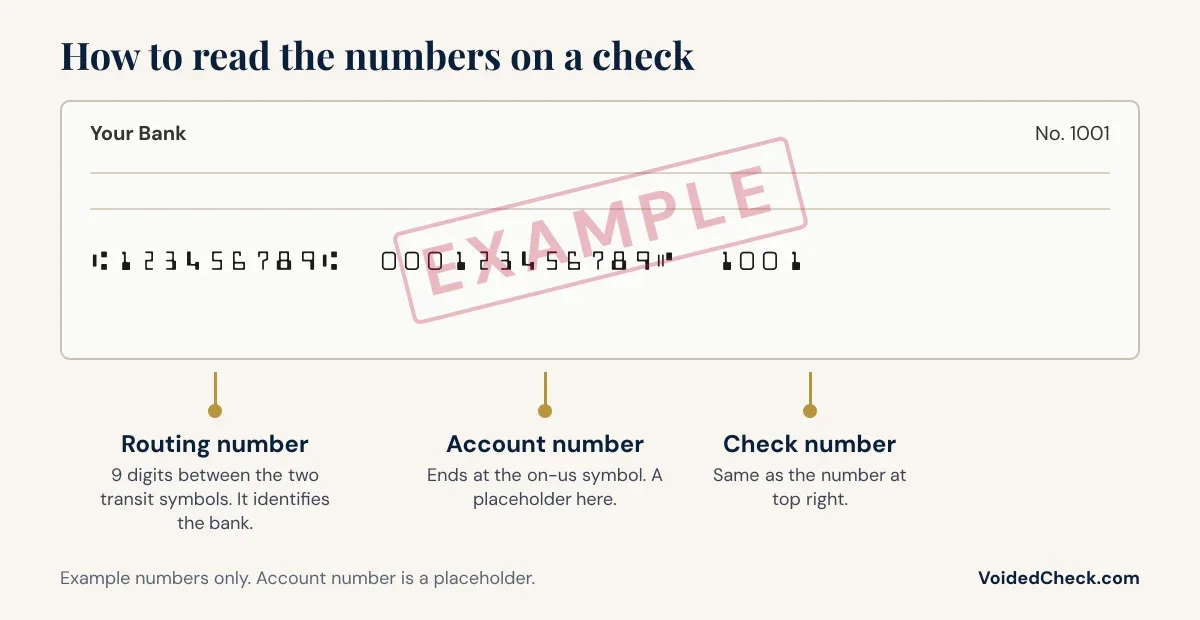
On a voided check, the routing number is the nine-digit number at the bottom left. Your account number comes next, in the middle, and the check number is on the right. The routing number identifies your bank, while the account number identifies your own account, so check both against your banking app.
On this page
When an employer, landlord or lender asks for a voided check, they are really asking for the numbers printed along the bottom of it. Knowing which number is which helps you check a voided check before you hand it over, and fill in a form correctly when you do not have one.
The short version
Look at the line of numbers along the bottom edge of the check. According to the American Bankers Association, the routing number is the left-most number, followed by your account number and then the check number (ABA).
- Routing number: nine digits, on the left. It identifies your bank or credit union.
- Account number: in the middle. It identifies your specific account.
- Check number: on the right. It usually matches the number printed in the top-right corner of the check.
Reading the bottom line of a check
The numbers along the bottom of a check are printed in a special machine-readable font so that banks can process checks automatically. Small symbols separate each group of numbers. You do not need to copy the symbols, only the digits.
The routing number
The routing number is always nine digits. The ABA calls it the ABA Routing Number, and LexisNexis Risk Solutions is the official registrar that assigns them to banks (ABA). It is not secret: it is the same for many customers of the same bank, and banks publish their routing numbers. If you want to understand what the number does, read what is a routing number.
The account number
Your account number comes after the routing number. Its length varies from bank to bank. This is the number that is unique to you, so treat it with care and share it only with people who need to pay you or collect a payment you have approved.
The check number
The last group is the check number. On a voided check it does not matter for direct deposit, but it helps you track which check you voided. Huntington suggests recording the voided check number in your checkbook so you do not wait for it to clear (Huntington).
Why the voided check matters
Banks and employers ask for a voided check because it shows the routing and account numbers exactly as your bank printed them. Writing "VOID" across the front means the check cannot be used for a payment if it is lost or stolen (Huntington). Our guide on how to void a check shows where to write it.
Those two numbers are what direct deposit and other ACH payments need. When your employer pays you, it sends your routing and account numbers to its bank, which passes the payment to your bank through the ACH network (Nacha).
Routing number vs. account number at a glance
| Routing number | Account number | |
|---|---|---|
| Where on the check | Left | Middle |
| Length | Nine digits | Varies by bank |
| Identifies | Your bank or credit union | Your account |
| Shared with other customers | Yes | No |
For a deeper comparison, see routing number vs. account number.
Don't have a check?
You can find the same numbers without a checkbook:
- Your bank's app or website. Most banks show both numbers on the account details screen.
- A bank statement. Statements usually show your account number and often the routing number.
- Our lookup. Search your bank on our routing number lookup to see the numbers our data lists for it. Use the one your bank tells you to use for your account.
If someone specifically needs a voided check, you can create a voided check online with your routing and account number and download it as a PDF.
Check the numbers before you submit
A wrong routing number can send a deposit to the wrong bank or get it returned. Before you submit a voided check or form:
- Compare the routing number with the one in your bank's app.
- Make sure the account number matches the account you want paid into.
- If your bank lists different routing numbers for different purposes, use the one it gives for direct deposits and ACH payments. The Federal Reserve's E-Payments Routing Directory lists routing numbers that receive ACH and wire payments (Federal Reserve Financial Services).
Our guide to finding your routing number shows where else to look.
Frequently asked questions
Which number on a voided check is the routing number?
The nine-digit number on the far left of the bottom line.
Which number on a voided check is the account number?
The number in the middle, between the routing number and the check number.
Is the routing number the same for every check from my account?
Yes. Every check from the same account shows the same routing and account numbers. Only the check number changes.
Is it safe to give someone a voided check?
Give one only to people who need it, such as your employer or a lender you have chosen. It shows your account number, which is private information.
Sources
Read next
- Routing numbersHow to Verify a Routing Number Before You Use ItA wrong routing number can delay a paycheck or refund. Five quick checks to verify a routing number before you give it to an employer or the IRS.
- Routing numbersHow to Find Your Bank Routing NumberLearn 5 easy ways to find your bank's routing number for direct deposit, wire transfers, and automatic payments.
- Routing numbersAlly Routing NumberAlly Bank's routing number is 124003116. Learn how to find your Ally routing and account number for direct deposit and wire transfers.
Ask an AI assistant to summarize this page
Prompt: “Summarize this page and list its key points: https://voidedcheck.com/blog/routing-number-on-a-voided-check”